คลังข้อมูล / Digital Library

รายการเผยแพร่ทั้งหมด 103 รายการ — คลิกที่การ์ดเพื่อดูรายละเอียดและเปิดแหล่งข้อมูล

ทั้งหมด Academic Articles Advanced Research Earthquake data Educational Resources External Links General Public Hazard Maps Kids & Schools Magnetotelluric Multimedia Public Articles Research Tools Resisitivity Data Seismic Data TSER2023 TSER2025 แกลเลอรี / Gallery รายการ / List
File TSER2023 Public
Enhancing Protective Building Design using Explicit Dynamic

Careful design of public buildings is needed to provide an optimized response that accounts for various loading cases, such as seismic, wind, and blast loads. Effective building design needs to be well-balanced for various scenarios. Fundamental understanding of structural behavi

1 Sep 2026
File TSER2023 Public
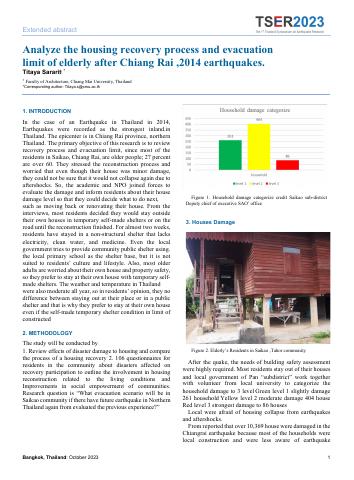
Analyze the housing recovery process and evacuation limit of elderly after Chiangrai 2014 earthquakes

In the case of an Earthquake in Thailand in 2014, Earthquakes were recorded as the strongest inland in Thailand. The epicentre is in Chiangrai province, northern Thailand. The primary objective of this research are to review recovery process and evacuation limit, since most of th

1 Sep 2026
File TSER2023 Public
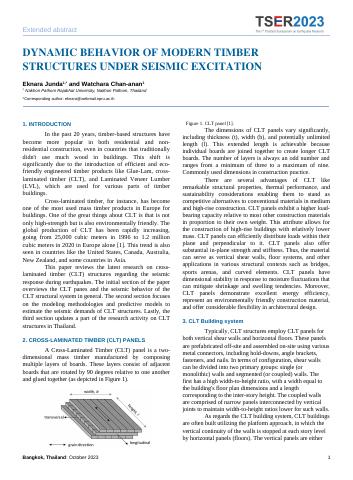
Dynamic behavior of modern timber structures under seismic excitation

Timber is a renewable and environmentally friendly building material that has gained popularity due to its strength and seismic resilience when engineered with modern techniques. As society increasingly emphasizes the importance of sustainable, resilient, and visually appealing a

1 Sep 2026
File TSER2023 Public
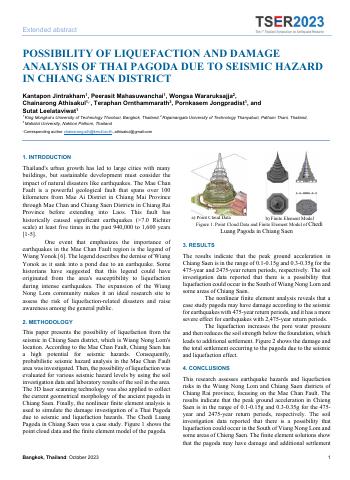
Possibility of liquefaction and damage analysis of Thai Pagoda due to seismic hazard In Chiang Saen district

According to the legend of Yonok Nakorn, Yonok City fell due to the tremendous seismic hazard in 1000 B.E. The The Yonok City sank into the ground, and that area became a large water reservoir called the Viang Nong Lom. Investigating this legend, which happened in northern Thaila

1 Sep 2026
File TSER2023 Public
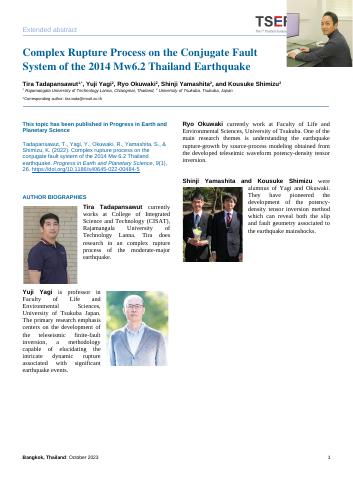
Complex rupture process on the conjugate fault system of the 2014 Mw 6.2 Thailand earthquake

A moment magnitude 6.2 crustal earthquake occurred in northern Thailand on 5 May 2014, and its aftershocks exhibit several lineaments with conjugate pattern, involving geometric complexity in a multi-segmented fault system of the Phayao fault zone. However, a relationship between

1 Sep 2026
File TSER2023 Public
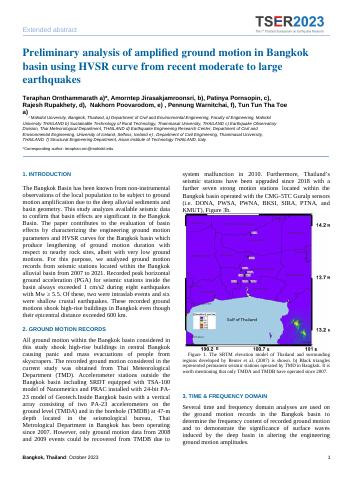
Preliminary analysis of amplified ground motion in Bangkok basin using HVSR curve from recent moderate to large earthquakes

The Bangkok Basin has been known from non-instrumental observations of the local population to be subject to ground motion amplification due to the deep alluvial sediments and basin geometry. The purpose of this study is to analyze a limited amount of seismic data to confirm that

1 Sep 2026
File TSER2023 Public
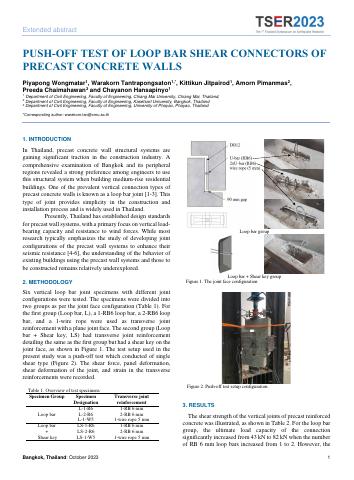
Push-off tests of loop bar shear connectors of precast concrete walls

Recently, precast concrete wall structural systems have gained significant attention in the construction industry. The structural system reveals a strong preference among engineers when building medium-rise residential buildings. One of the prevalent vertical connection types of

1 Sep 2026
File TSER2023 Public
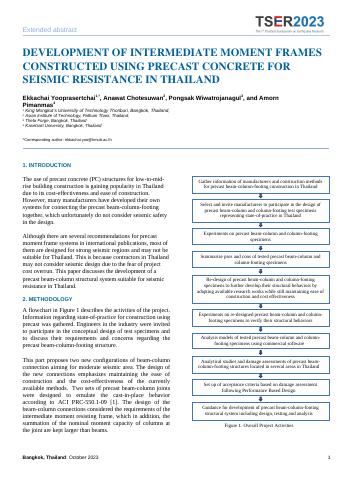
Development of intermediate moment frames constructed using precast concrete for seismic resistance in Thailand

Low-to-mid-rise building construction using precast concrete structures is becoming popular in Thailand. Manufacturers have developed systems to connect the precast concrete beams and columns. Their focus is mainly on ease of construction and cost-effectiveness. Unfortunately, mo

1 Sep 2026
File TSER2023 Public
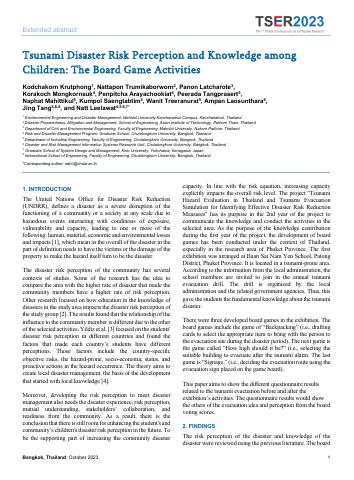
Tsunami Disaster Risk Perception and Knowledge among Children: The Board Game Activities

The 2004 Indian Ocean tsunami was one of the deadliest natural disasters in history, causing widespread damage and loss of life in Southeast and South Asia. In the years since the disaster, there has been a growing concern that disaster risk perception among children is decreasin

1 Sep 2026
File TSER2023 Public
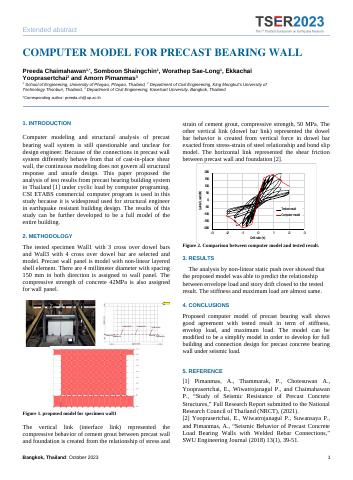
Computer model for precast bearing wall

This paper presents the analysis of test results from precast bearing building system in Thailand under cyclic load by computer programing. The tested specimen Wall1 with 3 cross over dowel bars and Wall3 with 4 cross over dowel bar are selected and model. Precast wall panel is m

1 Sep 2026
File TSER2023 Public
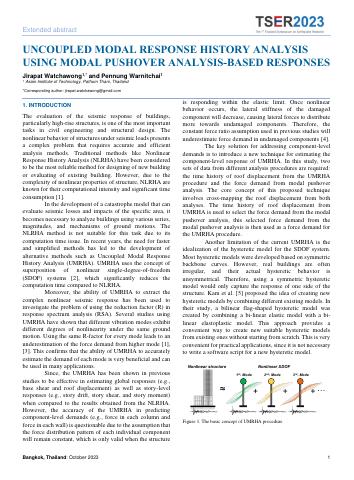
An accurate uncoupled modal response history analysis procedure based on modal pushover responses

Modal analysis is the foundation of seismic analysis. The Uncoupled Modal Response History Analysis (UMRHA) method can efficiently extract complex nonlinear seismic responses into individual mode responses, providing valuable insights into the contribution from each mode. The com

1 Sep 2026
File TSER2023 Public
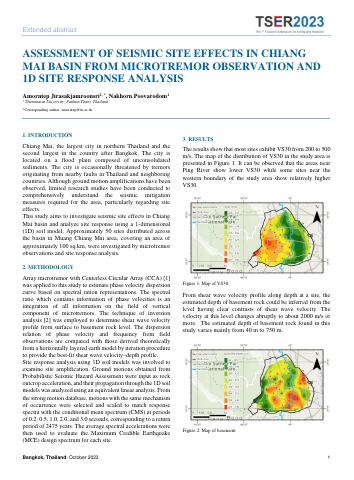
Assessment of seismic site effects in Chiang Mai basin from microtremor observation and 1D site response analysis

Chiang Mai, the largest city in northern Thailand and the second largest in the country after Bangkok. The city is located on a flood plain composed of unconsolidated sediments. The city is occasionally threatened by tremors originating from nearby faults in Thailand and neighbor

1 Sep 2026
File TSER2023 Public
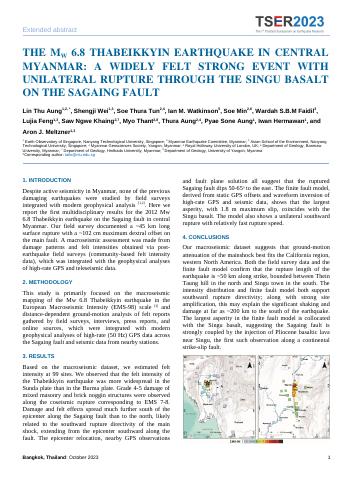
The 2012 MW 6.8 Thabeikkyin earthquake in central Myanmar: A widely felt strong event with unilateral rupture through the Singu basalt on the Sagaing fault

To understand the damage and physics processes of large earthquakes, it is important to integrate field surveys with modern geophysical analysis. Although Myanmar is seismically very active, such integration was never conducted in the past. Here we make the first report of its ki

1 Sep 2026
File TSER2023 Public
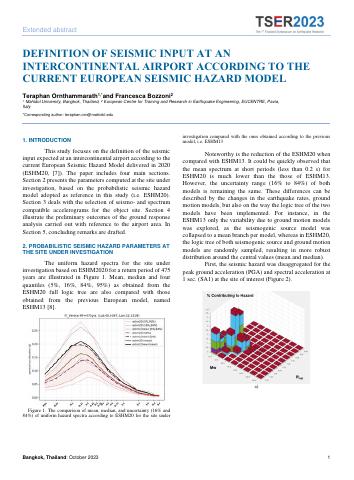
Definition of seismic input at an intercontinental airport according to the current European seismic hazard model

In this study, a preliminary 1D fully stochastic site response analyses (100 simulations) for Venice airport were carried out by accounting for the uncertainty of soil model parameters as well as the variability of seismic input. Although the seismicity at the site of the airport

1 Sep 2026
File TSER2023 Public
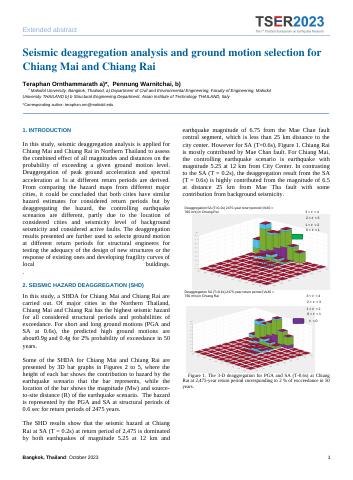
Seismic deaggregation analysis and ground motion selection for Chiang Mai and Chiang Rai

In this study, seismic deaggregation analysis is applied for Chiang Mai and Chiang Rai in Northern Thailand to assess the combined effect of all magnitudes and distances on the probability of exceeding a given ground motion level. Deaggregation of peak ground acceleration and spe

1 Sep 2026
File TSER2023 Public
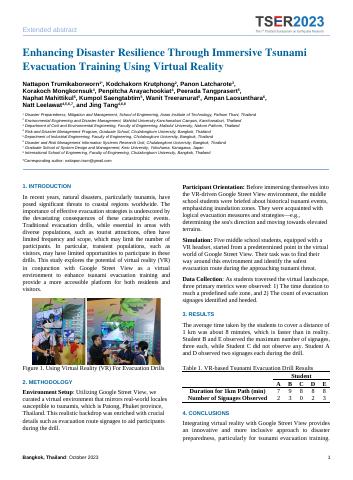
Enhancing disaster resilience through immersive tsunami evacuation training using virtual reality

Natural disasters, particularly tsunamis, pose significant threats to coastal regions. Traditional evacuation drills have limitations in terms of frequency and inclusivity, especially for transient populations. This research explores the use of Virtual Reality (VR) in conjunction

1 Sep 2026
File TSER2023 Public
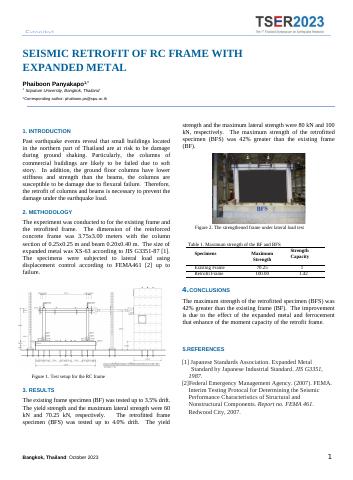
Seismic retrofit of RC frame with expanded metal

Generally, the damage of the commercial building during an earthquake was due to soft story failure of the ground floor columns because the ground floor columns are more slender and higher than the upper floors. This paper presents the retrofit of the reinforced concrete frame us

1 Sep 2026
File TSER2023 Public
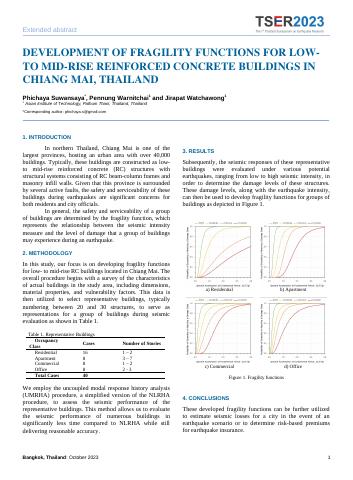
Development of fragility functions for low- to mid-rise reinforced concrete buildings in Chiang Mai, Thailand

In northern Thailand, Chiang Mai is one of the largest provinces, hosting an urban area with over 40,000 buildings. Typically, these buildings are constructed as low- to mid-rise reinforced concrete (RC) structures with structural systems consisting of RC beam-column frames and m

1 Sep 2026
File TSER2023 Public
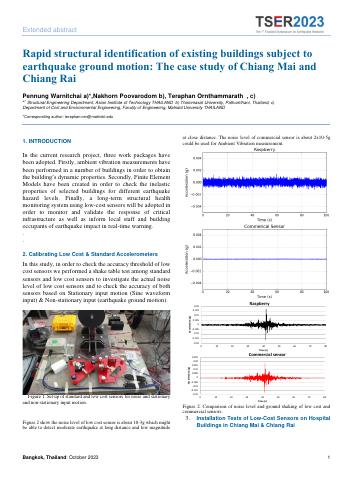
Rapid structural identification of existing buildings subject to earthquake ground motion: The case study of Chiang Mai and Chiang Rai

In the current research project, three work packages have been adopted. Firstly, ambient vibration measurements have been performed in a number of buildings in order to obtain the building's dynamic properties. Secondly, Finite Element Models have been created in order to check t

1 Sep 2026
File TSER2023 Public
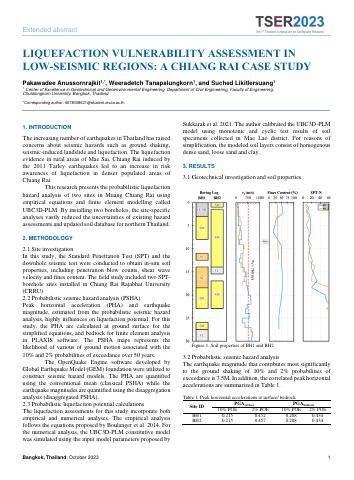
Liquefaction Vulnerability Assessment in Low-Seismic Regions: A Chiang Rai, Thailand Case Study

The liquefaction concerns of the foundation ground in urban zones of Chiang Rai arises from a prior instance of liquefaction occurring in remote northern Thailand in 2011. Most areas are underlain by clayey sand deposits from paleochannels, which are highly susceptible to liquefa

1 Sep 2026
File TSER2023 Public
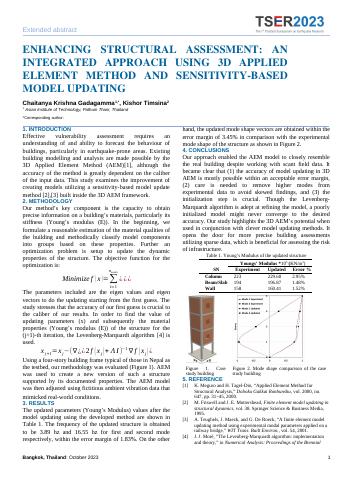
Enhancing Structural Assessment: An Integrated Approach Using 3D Applied Element Method and Sensitivity-Based Model Updating

Effective vulnerability assessment requires an understanding of and ability to forecast the behaviour of buildings, particularly in earthquake-prone areas. Existing building modelling and analysis are made possible by the 3D Applied Element Method (AEM), although the accuracy of

1 Sep 2026
File TSER2023 Public
Seismic fragility of gypsum partition walls

In recent decades, the seismic response of building nonstructural components has received increased attention because of their relatively high investment cost for new construction and associated repair cost following earthquakes. Based on estimates from past earthquakes, nonstruc

1 Sep 2026
File TSER2023 Public
Effects of Infill Wall Models on Vibration Period and Seismic Response of a Building

Nonlinear Response History Analysis (NLRHA) is a dynamic method for analyzing structures subjected to earthquakes. This approach considers the nonlinear behavior of building materials and components, enabling the calculation of the responses during nonlinear behavior and often yi

1 Sep 2026
File TSER2023 Public
A 1D velocity model of northern Thailand: Preliminary results

The earthquakes in Thailand and adjacent areas have been monitored by earthquake observation division, Thai Meteorological Department (TMD). The earthquake location was calculated by using a global velocity model IASP91 (Kennett and Engdahl, 1991). The earthquake location mainly

1 Sep 2026